
The glucagon like peptide-1 receptor (GLP-1R) is a class B G-protein-coupled receptor (GPCR) and one of the most therapeutically important targets in metabolic disease. Its activation promotes insulin secretion, reduces appetite, and modulates inflammation, making it central to approved treatments for type 2 diabetes and obesity.1 Understanding how different therapeutic modalities engage GPCRs in their native cellular context is critical for both drug discovery and mechanistic biology.2 Here, we present a comparative live cell binding analysis of three distinct ligand classes targeting the GLP-1R overexpressed in HEK293 cells: the small molecule orforglipron (an FDA-approved GLP-1R agonist), the peptide semaglutide (a widely studied GLP-1 analog for weight loss and inflammation), and an anti-GLP-1R monoclonal antibody directed against the extracellular domain (ECD).3&4 All measurements were performed in live cells to preserve receptor conformation, membrane organization, and native accessibility, enabling resolution of modality specific binding behavior.
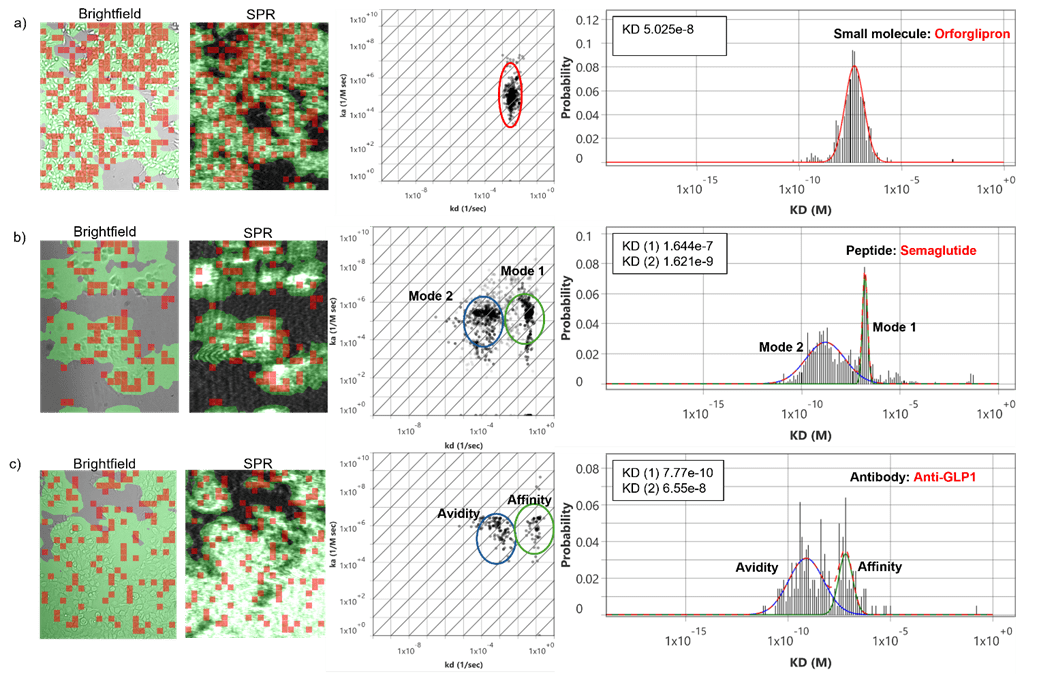
Figure 1: Comparative live-cell SPRM binding analysis of GLP-1R ligands with distinct modalities. (a) Orforglipron vs GLP-1R: Small-molecule binding to GLP-1R-overexpressing HEK293 cells shows a single, high-affinity population, consistent with a uniform binding mode. (b) Semaglutide vs GLP-1R: Peptide ligand displays two distinct binding populations, corresponding to high-affinity (Mode 1) and lower-affinity (Mode 2) interactions, reflecting heterogeneous receptor engagement or conformational states. (c) Anti-GLP-1 vs GLP-1R: Monoclonal antibody binding reveals dual populations consistent with monovalent affinity and avidity-driven interactions, indicative of multivalent engagement with receptor clusters on the cell surface.
The small molecule orforglipron exhibits a single, well-defined binding mode characterized by a narrow KD distribution centered in the nanomolar range 50.25 nM (Figure 1a). The unimodal distribution indicates a homogeneous interaction population with minimal heterogeneity. Spatially, binding events are consistent with engagement of the exposed regions of the transmembrane domain (TMD), where small molecules access a defined binding pocket. This behavior reflects direct and specific interaction with the GLP-1 receptor, resulting in a single dominant kinetic population.
In contrast, the peptide semaglutide displays two distinct binding modes, reflected in a bimodal KD distribution. The ka/kd scatter plot resolved into two spatially distinct clusters, labelled Mode 1 and Mode 2. The KD histogram was correspondingly bimodal: Mode 1 at 164 nM reflects rapid ECD engagement by the peptide’s N-terminal helical segment, while Mode 2 at 1.62 nM reflects the subsequent tighter insertion of the C-terminal agonist region into the TMD bundle (Figure 1b). This two-step sequential binding mechanism is ECD docking, followed by TMD penetration is unique to peptide agonists and is only resolvable in an intact cell SPRM experiment. The ~100-fold difference in KD between the two modes explains the high potency and prolonged receptor residence time that distinguish semaglutide from purely TMD targeted ligands. The observed heterogeneity arises from differences in how these domains are accessed and engaged on the cell surface, producing distinct kinetic populations that reflect full receptor engagement.
The anti-GLP-1R antibody, which targets the extracellular domain, exhibits two kinetically distinct populations corresponding to affinity and avidity driven interactions. The anti-GLP-1R monoclonal antibody, which targets ECD exclusively, also produced two kinetically resolved populations, but their physical interpretation is entirely different from the peptide case. Here the two clusters are labelled Affinity and Avidity. The Affinity population, with KD = 65.5 nM, represents monovalent single-site engagement of one Fab arm with a single ECD epitope. The Avidity population, with KD = 0.78 nM, arises from bivalent crosslinking of two spatially proximate ECD epitopes with both Fab arms simultaneously (Figure 1c). The ~80-fold enhancement in functional affinity conferred by avidity is a direct consequence of the native receptor organization on the plasma membrane, and it is absent from any assay using purified or solubilized protein. Ensemble measurements using SPR may be able to detect avidity effects; however, the data generated represents a mixture of binding mechanisms. In comparison, SPRM can provide the ability to quantify and differentiate affinity and avidity populations simultaneously. This avidity-driven behavior is strongly influenced by receptor density and spatial organization on the cell surface and is a defining feature of antibody receptor interactions that cannot be captured in simplified biochemical systems.
Taken together, it becomes evident that SPRM allows resolving entirely different mechanisms of ligand receptor binding using the same experimental system. Small molecules display one type of binding mechanism, involving only the transmembrane region of the receptor. Peptides show multimodal ligand binding through their interaction with various regions of the GLP-1R molecule. Antibodies can induce an avidity effect leading to multivalency of ligand interactions. It is important to note that such an approach is vital for understanding the true nature of ligand receptor binding and gaining essential information for drug design and optimization.
DOWNLOAD PDF
Download a PDF of Application Note 178: Modality-Dependent Binding to GLP-1R on Live Cells
- Drucker DJ, Cell Metabolism. 2018 Apr 3;27(4):740-56.
- MüllerD et al, Molecular Metabolism 30 (2019): 72-130.
- Knudsen et al, Frontiers in Endocrinology 10 (2019): 155.
- Wharton et al, New England Journal of Medicine 389.10 (2023): 877-888.