
There is a growing need for enhanced diagnostic technologies to provide high sensitivity, selectivity, and reproducibility in biosensors. Human chorionic gonadotropin (hCG), a relevant clinical biomarker linked with fetal defects, Down’s Syndrome (DS), and pregnancy related diseases, has been a focus for developing advanced biosensors.1 Although a variety of methods for detecting hCG exist in literature, it remains a challenge for these methodologies to offer ultralow detection thresholds avoiding antibodies.2
To meet this challenge, a carboxyl-functionalized graphene oxide (carboxyl-GO) surface plasmon resonance aptasensor for rapid, precise measurement of hCG in serum has been developed by researchers at the National Taiwan Normal University.3 This aptasensor exploits the special properties of carboxyl groups of GO sheets, which provide enough reactive sites for easy conjugation with aptamers that possess a peptide with a free amino terminus and a C-terminal carboxyl group, and a sulfur-containing side chain making it robust (Figure 1) to provide a stable aptasensor surface which is valuable to those that use antibodies.
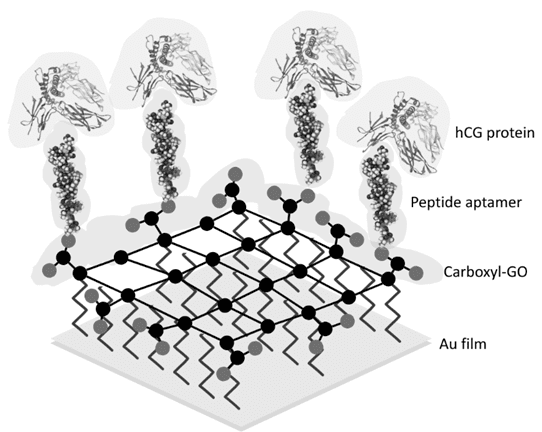
Figure 1: A schematic diagram of chemical coupling to carboxyl-GO sheets and peptide probe immobilization on the surfaces of SPR aptasensors to produce a thiol-reactive coupling surface. Monoclonal peptides were immobilized on carboxyl-GO surfaces via NH2-COOH interactions. The interaction between the hCG analyte and biorecognition peptide created a signaling event SPR angle shift by the interfaced carboxyl-GO film.
With this SPR sensing method, the carboxyl-functionalized GO-based SPR aptasensor displayed excellent analytical performance. In the clinical serum sample experiment, serum samples from normal pregnant women (NPW) and women with fetal Down’s syndrome (FDSW) were screened. Analysis showed a high binding affinity and sensitivity for a wide range of concentrations from 1.9 to 135 pM (Figure 2A). Additionally, in a few samples from pregnant women between 12 and 19 weeks, it was found that an SPR angle change of over 20 millidegree indicated a significantly increased risk of Down’s syndrome in the baby, as opposed to normal pregnancies. In sensitivity analysis, the detection limits of the carboxyl-GO-based SPR aptasensor was 1.9 pM for the serum samples. This is approximately several orders of magnitude lower than that of conventional SPR without the carboxyl GO aptamers, indicating the feasibility of using this method to screen for DS. Furthermore, this peptide-carboxyl-GO film showed excellent strong binding properties requiring a smaller sample volume and thereby significantly lowering the concentration required for the SPR aptasensor assay. More significantly, it could appreciably reduce the non-specific adsorption of molecules. The screening for fetal DS in the 5k-fold dilution factor showed a statistically significant difference (P= 0.004). This also reflects that this sensor has a robust sensing film that can withstand a 5,000-fold sample dilution (Figure 2B).
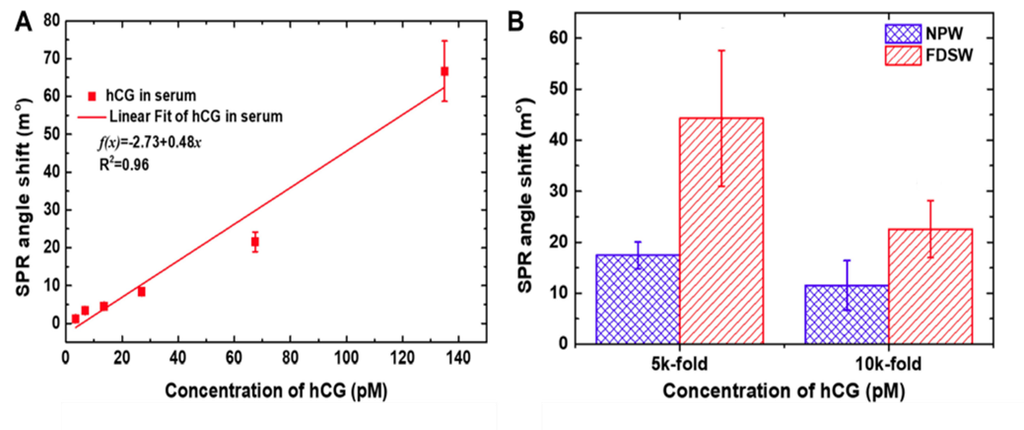
Figure 2: Plot of the results of the calibration curve of clinical serum samples and analysis of SPR angle shift with assay specificity using the peptide-based SPR biosensor for carboxyl-GO film. (A) Calibration curves of average SPR detection with various hCG protein concentrations ranging from 1.9 pM to 135 pM in the serum samples. The error bars represent the SD of three replicates. (B) Correlation between two variables of the NPW and FDSW groups in serum samples. The proportion of healthy NPW group were significantly reduced in the 5k and 10k-fold dilution factor compared to the FDSW group. Results are expressed as means ± SD of three independent experiments, each performed in triplicate.
This work, to our knowledge, represents the first example of using a carboxyl GO-based SPR aptasensor in a clinical setting for screening fetal Down’s syndrome by detecting hCG. The differences between serum samples of Down’s syndrome pregnancies and normal ones are significant, which indicates a high potential of this material for diagnostic use. This study further supports earlier observations that GO-based and GO-COOH-based sensing films are effective in increasing SPR sensitivity due to their high reactivity and surface area that facilitate peptide immobilization. The bio affinity of carboxyl GO in conjunction with selective properties of peptide aptamers provides a flexible approach for developing a sensing structure for SPR analysis for wide-ranged clinically valuable substances, including those used for monitoring of pregnancies and cancer markers.
This short note is based on the work from Prof. Nan-Fu Chiu’s research lab at National Taiwan Normal University.
Author: Nguyen Ly, and Miyuki Thirumurthy | Biosensing Instrument | Published March 10, 2026
DOWNLOAD PDF
Download a PDF of Application Note 175: Highly Sensitive Detection of hCG Using Graphene Oxide-Based Surface Plasmon Resonance Aptamers
- Barnhart KT et al, Obstet Gynecol. 2016;128:504–511.
- Palacio M et al, Ultrasound Obstet Gynecol. 1999;13:58–62.
- Chiu, Nan-Fu et al, International journal of nanomedicine (2020): 8131-8149.