
Carbon dioxide (CO₂) capture is a key approach to addressing the present climate crisis because of over emission of greenhouse gases. As the dominant human-made cause of global warming, CO₂ must be efficiently extracted from industrial emissions and the atmosphere, to counteract the effects of climate change and attain global climate goals.1 The common technologies used for CO₂ capture, including solvent-based absorption, solid adsorption, cryogenic separation, and membrane-based technologies with mixed levels of success are generally plagued by significant drawbacks such as high energy costs, material degradation, and complex operation.2-4
Electrochemical CO₂ capture technologies are growing to be ever more prominent as a promising alternative solution by virtue of their lower energy demand, tunable selectivity, and compatibility with renewable energy.5 Electrochemical systems, unlike thermal systems, can potentially regulate carbon dioxide adsorption and desorption by means of applied voltage which is more efficient and reversible.6 Techniques such as super capacitive swing adsorption (SSA) reversibly adsorb CO₂ on electrode surfaces. However, the quality of these methods is essentially regulated by interfacial processes that are still poorly understood and documented.7
One of the most critical parameters influencing electrochemical CO₂ capture performance is the conductivity of dissolved CO₂ at the electrode/electrolyte interface under applied potential. This impact directly relates to the structure of the electrical double layer (EDL), ion distribution, and resultant interfacial capacitance parameters that all dictate CO₂ absorption capacity and selectivity.8 Understanding how dissolved CO₂ affects the interfacial environment is therefore essential to advance electrochemical capture system design and maximize their efficiency.9
To look into this, scientists from the Department of Chemistry at the University of Illinois Urbana-Champaign (UIUC) in collaboration with the Materials Science and Engineering Department at North Carolina State University (NCSU) conducted Electrochemistry combined with Surface Plasmon Resonance (EC SPR) studies to establish the adsorption behavior of CO₂ and Argon (Ar) at the interface of a planar polycrystalline gold electrode under applied potential in a neutral aqueous electrolyte.10 EC SPR is a sensitive, non-destructive technique to monitor interfacial alteration at the electrode-electrolyte interface in real time. The method relies on the observation of the variation in SPR angle as a function of the local refractive index at the metal surface and as a function of the changes in ion distribution, surface charge, and electrical double layer (EDL) structure (Figure 1).
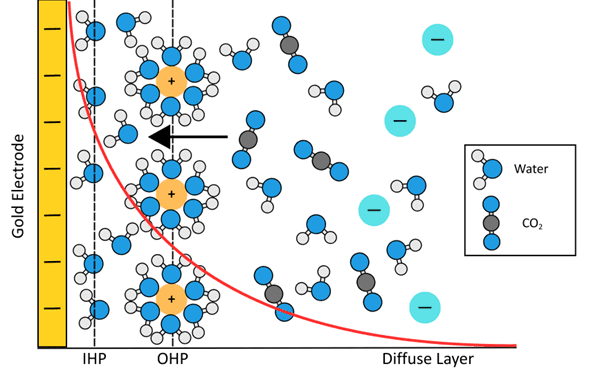
Figure 1: Schematic for the behavior of CO2 in the EDL
EC SPR was performed using BI-2500 to investigate the difference between the interfacial capacitance of gold chips in 0.1 M sodium sulfate in two different environments: one saturated with argon (Ar, pH ≈ 7.0) and the other with carbon dioxide (CO₂, pH ≈ 4.0). Figure 2a, b and c show the oscillating changes of the SPR angle when cyclic voltammetry was performed between −0.3 to +0.3 V at 100 mV/s. SPR angle changed with applied voltage in both cases, but the response was significantly altered in the presence of CO₂. Specifically, capacitance decreased by 5–22% in the presence of CO2, with variation depending on electrolyte state, having more variation at more extreme potentials. This suggests molecular CO₂ to accumulate in the diffuse layer of the electrode interface, lowering surface charge and interfacial capacitance. The work sheds light on how CO₂ influences charge dynamics at the interface and points toward factors that may enhance CO₂ uptake in aqueous electrochemical systems like SSA. CO₂ made some definite changes in the SPR response, indicating that dissolved CO₂ plays a role in interfacial charge dynamics. The shift of the SPR angle arises from the accumulation/depletion of capacitive charge, shown in Figure 2d.
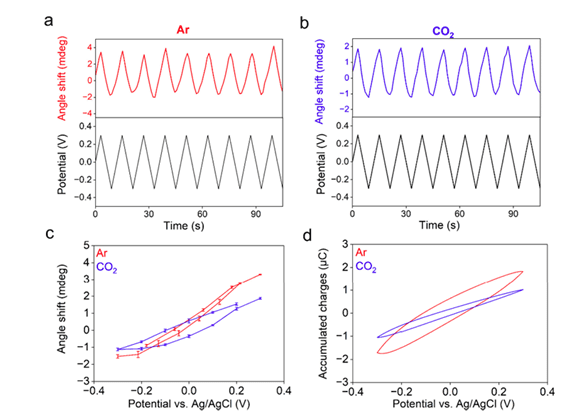
Figure 2: EC SPR on gold chips in 0.1M Na2SO4 between −0.3 and +0.3 V 100 mV/s. Shift in the SPR angle and applied potential as a function of time in 0.1M Na2SO4 saturated with (a) Ar (pH7.0±0.2) or (b)CO2 (pH4.0±0.2). (c)The shift in SPR angle as a function of potential, calculated from 2 and b. (d) The accumulated charge as a function of potential, calculated from Figure 2b.
These findings demonstrate that EC SPR is a strong and viable method for probing the influence of dissolved CO₂ on the interfacial environment of electrochemical systems. Overall, the study highlights the importance of understanding the CO₂ behavior at the molecular level at electrified interfaces for optimizing electrochemical CO₂ capture devices. By correlating CO₂ presence within the EDL to variations in interfacial capacitance, researchers can gain important insight into sorption mechanisms and improve system performance through material and process improvement.
We thank Prof Joaquín Rodríguez-López from UIUC for collaborating with us in the write up of this application note. Materials is a summary of Ding et al. “Dissolved CO2 Modulates the Electrochemical Capacitance on Gold Electrodes.” ACS Electrochemistry 1.4 (2025): 476-485.
DOWNLOAD PDF
Download a PDF of Application Note 171: Probing the Role of Dissolved CO₂ in Electrochemical Interfaces via EC SPR
- IPCC. (2022). Climate Change 2022: Mitigation of Climate Change. Contribution of Working Group III to the Sixth Assessment Report of the Intergovernmental Panel on Climate Change.
- Rochelle, G. T. (2009). Science, 325(5948), 1652–1654.
- Wang et al (2011). Chemical Engineering Research and Design, 89(9), 1609–1624.
- Song et al (2018). Renewable and Sustainable Energy Reviews, 82, 353–371.
- Voskian et al (2019). Energy & Environmental Science, 12(11), 3530–3547.
- Endrődi et al (2020) Nature Energy, 5, 786–795.
- Forse et al (2021). Chem, 7(2), 340–360.
- Zhang et al (2020). Nature Reviews Chemistry, 4, 167–179.
- Lee et al. (2021). ACS Applied Materials & Interfaces, 13(4), 5440–5450.
- Ding et al (2025). ACS Electrochemistry 1, no. 4: 476-485.