
Mucin 4 (MUC4) is a highly glycosylated cell surface protein that is highly overexpressed in cancerous cells of the pancreas, including the BxPC3 cell line. 1, 2 Due to its tumor-specific expression and cell surface localization, MUC4 is an attractive target for therapeutic antibody and vaccine approaches.3 However, this protein is complex and heavily glycosylated nature, it is a formidable challenge to conventional isolation and purification schemes.
Surface plasmon resonance microscopy (SPRM) offers a compelling solution to this problem by offering real-time, label-free detection of molecular interactions with living cells, directly and without the need to purify the receptor. SPRM is well-suited to examine difficult membrane targets like MUC4 in their native conformation on the cell surface.4
To establish simultaneous binding specificity, kinetic antibody titration of anti-MUC4 antibodies against BxPC3 cells (MUC4-positive cell line) and against HEK293T cells (MUC4-negative cell line) on a two-well SPRM chip was performed. HEK293T cells which lack endogenous expression of MUC4 were seeded on one side of the barrier and the other side was dedicated to BxPC-3 cells on the sensor as shown in Figure 1 & 2A.

Figure 1: Schematic showing the SPRM setup with the two-well SPRM chip which has BxPC3 cells on one side and HEK293 cells seeded on the other side of the barrier.
A two-well SPRm chip greatly enables kinetic binding analysis by virtue of high-throughput, side-by-side comparison of interactions between receptors and ligands. Through this set-up, researchers can view, at the same time, binding kinetics of target receptor-expressing cells and control cells that are not expressing the receptor under a single experiment. Both cell populations are subjected to the same analyte concentrations under the same conditions, which cancels experimental variance but still offers a direct and an accurate comparison of binding affinity and specificity. Simultaneous kinetic analysis using a two-well chip facilitates faster data collection with greater consistency saving time and resources.
Data analysis involved the delineation of regions of interest (ROIs) around each type of cell so that the binding response could be quantified independently. Each cell population was analyzed with the same number of regions of interests (ROIs). The kinetic analysis generates two data files, with binding activity and kinetic information for each of the cell types. The kinetic results revealed two distinct anti-MUC4 binding interaction modes to the BxPC3 cells that express the target receptor (Figure 2B). Binding interaction of anti-MUC4 showed two distinct modes (a and b) due to the bivalency of the antibody and the presence of heterogenous binding populations. On the other hand, no binding response was seen for the HEK293T cells (Figure 2C), thereby demonstrating the specificity of the interaction.
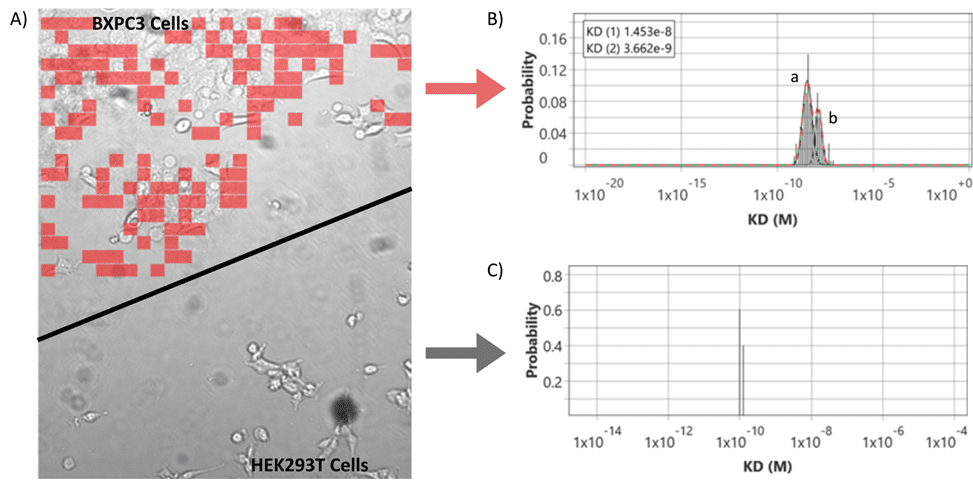
Figure 2: Anti-MUC4 interaction with BxPC3 and HEK293T cells. A) Bright field image of a two-well SPRm chip with BXPC-3 cells (positive) on the top and HEK293T cells (non the lower end divided by a barrier blank area. B) Histograms describing total kinetic interactions and distributions for anti-MUC4 on BxPC-3 cells C) Histograms describing the lack of kinetic interactions for anti-MUC4 on HEK293T cells.
This approach offers a high-throughput approach to kinetic analysis of cell surface receptors, demonstrating the utility of SPRM to examine interactions in whole cells without protein purification.
Author: Nguyen Ly, Miyuki Thirumurthy, and Jesús Aguilar Díaz de león | Biosensing Instrument | Published September 17th, 2025
DOWNLOAD PDF
Download a PDF of Application Note 169: Simultaneous Kinetic Binding Analysis of Anti-Mucin-4 on Pancreatic Cancer and HEK293T Cells Using Two-well SPR Microscopy Chip
- Chaturvedi, Pallavi, Ajay P. Singh, and Surinder K. Batra,The FASEB journal 22, no. 4 (2007): 966.
- Singh, Ajay P., Nicolas Moniaux, Subhash C. Chauhan, Jane L. Meza, and Surinder K. Batra, Cancer research 64, no. 2 (2004): 622-630.
- Jaiswal, Sunidhi, Siamak Amirfakhri, Javier Bravo, Keita Kobayashi, Abhijit Aithal, Sumbal Talib, Kavita Mallya ,Cancers 17, no. 12 (2025): 2031.
- Aguilar Díaz de león, Jesús S., Miyuki Thirumurthy, and Nguyen Ly, Plos one 19.5 (2024): e0304154.