
Aptasensors have rapidly become informative tools in modern diagnostics due to their fast response, excellent specificity, and readability for a large range of complex samples. Biosensors exploit the unique molecular recognition properties of aptamers which are short oligonucleotides capable of binding target molecules with unprecedented affinity and selectivity (Figure 1). Aptamers also have advantages over traditional antibodies, including improved chemical and thermal stability, reproducible synthesis, and simple functionalization for immobilization at a specific site.1
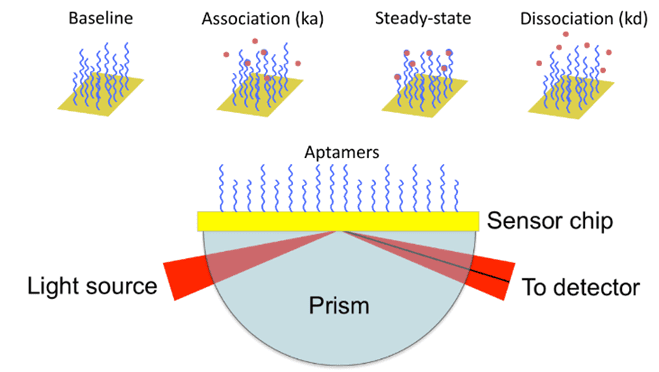
Figure 1: Schematic illustration for the principle and process of aptamer-based SPR assay.
A critical variable for aptasensor performance is directional immobilization of aptamers onto the surface of the sensor. Directional immobilization maximizes the accessibility of the binding site of the aptamer and reduces steric hindrance, thereby enhancing the maximum signal output for target recognition. This is typically achieved by introducing terminal thiol groups at 5′ or 3′ ends of the aptamer for efficient and oriented adsorption onto gold surfaces or nanostructured substrates such as gold nanoparticles and MXene nanosheets (two-dimensional nanomaterials made of transition metal carbides and/or nitrides).2 These substrates are particularly attractive due to their high conductivity, biocompatibility, large surface area, and easy functionalization.
Surface plasmon resonance (SPR) has been extensively utilized to validate aptamer-target interactions and prove immobilization techniques.3 Researchers from the “Iuliu Hatieganu” University of Medicine and Pharmacy in Cluj-Napoca, Romania developed several SPR-based aptasensors for the detection of clinically significant molecules like 1) vancomycin (VAN), 2) N-3-oxo-dodecanoyl-L-homoserine lactone (3-Oxo-C12-HSL), and 3) Protein A (PrA).
In the first study, thiol-modified aptamers were immobilized on cauliflower-shaped gold nanostructures on printed carbon electrodes to detect VAN.4 The interaction of the immobilized aptamer with different concentrations of VAN in solution was monitored and analyzed for obtaining both kinetics and equilibrium parameters. The normalized, blank-subtracted sensorgrams were fit to a 1:1 kinetic binding model and a steady-state affinity model. SPR sensorgrams provided an association rate constant (kon) of 3.44 ± 1.38 × 10³ µM⁻¹·s⁻¹ and a dissociation rate constant (koff) of 0.064 ± 0.03 × 10³ s⁻¹. The KD value (18.31 ± 1.15 µM), as calculated by koff/kon ratio, was very similar to that found in aptamer selection studies as seen in Figure 2. The outcome emphasizes thiol-based directional immobilization as a significant factor in enhancing aptasensor selectivity and performance, particularly in real biological matrices such as human serum and milk.
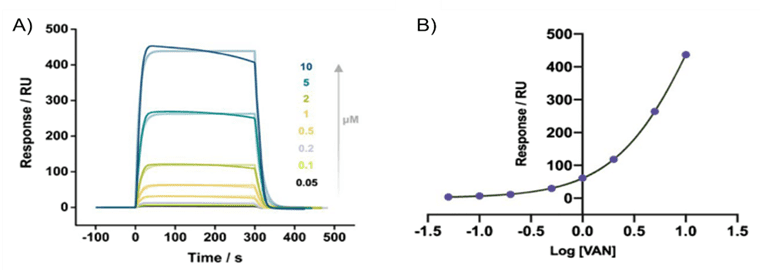
Figure 2: SPR analysis: A) Sensorgrams representing the kinetic binding profile of VAN-Apt (representative normalized, blank subtracted SPR sensorgrams for eight concentrations of VAN (0.05, 0.1, 0.2, 0.5, 1, 2, 5, and 10 µM); the colored more transparent lines represent the fit of experimental data to a 1:1 kinetic binding model). B) Corresponding equilibrium binding curve (fitted to a steady state affinity model (n=3)). SPR experimental conditions: 60 µL/min flow rate, injections of 300 s, 100 s dissociation time.
In addition to SPR, aptamer-functionalized surfaces prefer compatibility with electrochemical transduction methods. Aptamers generally undergo conformational alterations with target binding to modulate electron transfer properties at the surface. The BI-SPR instruments also supports electrochemical measurements as a separate application, extending the functionality of aptamer immobilized surface beyond SPR and enabling versatile analysis for a wide range of biosensing studies.
These aptamer efficiencies are especially advantageous in the detection of Quorum sensing (QS) molecules and bacterial proteins regulating microbial communication, biofilm formation, and antibiotic resistance. In the second study, researchers have reported the development of the first electrochemical aptasensor for the detection of 3-Oxo-C12-HSL with a gold nanoparticle modified carbon-based screen-printed electrode.5 The detection of 3-Oxo-C12-HSL molecule which is a part of Pseudomonas aeruginosa QS circuitry provides a measure of bacterial population activity. Extending this platform, a competitive electrochemical aptasensor for the detection of PrA was developed in the third study.6 PrA is a surface protein and virulence factor of Staphylococcus aureus. This system utilized a ferrocene-labeled complementary DNA (cDNA-Fc S13) hybridized with an aptamer of known affinity. Real-world matrix validation in the guise of spiked urine, microbial culture medium, and bacterial suspensions confirmed its useability.
These studies recognize the central role of directional aptamer immobilization and SPR-based interaction profiling in constructing advanced biosensing platforms. Aptamer integration with designed nanoarchitectures such as gold nanoparticles and MXenes is extremely useful because of enhanced sensitivity, selectivity, and device miniaturization. These developments make it possible to advance towards portable, disposable biosensors for point-of-care diagnostics and environmental monitoring. Since there is growing demand for rapid, low-volume, and affordable diagnostic devices, aptasensors are at the forefront of this wave with a powerful combination of precision, versatility, and usability.
We thank the researchers from University of Medicine and Pharmacy in Cluj-Napoca, Romania for collaborating with us in the write up of this application note.
Author: Nguyen Ly and Miyuki Thirumurthy | Biosensing Instrument | Published August 4th, 2025
DOWNLOAD PDF
Download a PDF of Application Note 168: Enhanced SPR Detection of Small Molecules and Bacterial Markers Using Directionally Immobilized Aptamers on Engineered Nanoplatforms
- Song et al, 2008. "Aptamer-Based Biosensors." Trends in Analytical Chemistry 27 (2): 108–117.
- Zhou et al, 2020. "Gold Nanomaterials for Aptamer-Based Biosensors." Biosensors and Bioelectronics 166: 112471.
- Ostatná et al, 2008 "Effect of the immobilisation of DNA aptamers on the detection of thrombin by means of surface plasmon resonance." Analytical and bioanalytical chemistry 391: 1861-1869.
- Bibani et al, 2025 "Electrochemical aptasensor for the selective detection of vancomycin based on nanostructured “in-lab” printed electrodes." Microchimica Acta 192: 107.
- Capatina et al, 2022 "Label-free electrochemical aptasensor for the detection of the 3-O-C12-HSL quorum-sensing molecule in Pseudomonas aeruginosa." Biosensors 12: 440.
- Tătaru et al, 2024. "Competitive Electrochemical Apta-Assay Based on cDNA–Ferrocene and MXenes for Staphylococcus aureus Surface Protein A Detection." Biosensors 14: 636.